Monday, August 29, 2011

Six Years After Katrina, The Battle for New Orleans Continues

Political power has shifted to whites, but blacks have not given up their struggle for a voice -- and justice.

By Jordan Flaherty

Published today on The Root: http://www.theroot.com/views/battle-new-orleans-continues

As this weekend’s storm has reminded us, hurricanes can be a threat to U.S. cities on the East Coast as well the Gulf. But the vast changes that have taken place in New Orleans since Katrina have had little to do with weather, and everything to do with political struggles. Six years after the federal levees failed and 80 percent of the city was flooded, New Orleans has lost 80,000 jobs and 110,000 residents. It is a whiter and wealthier city, with tourist areas well maintained while communities like the Lower Ninth Ward remain devastated. Beyond the statistics, it is still a much contested city.

Politics continues to shape how the changes to New Orleans are viewed. For some, the city is a crime scene of corporate profiteering and the mass displacement of African Americans and working poor; but for others it’s an example of bold public sector reforms, taken in the aftermath of a natural disaster, that have led the way for other cities.

In the wake of Katrina, New Orleans saw the rise of a new class of citizens. They self-identify as YURPs – Young Urban Rebuilding Professionals – and they work in architecture, urban planning, education, and related fields. While the city was still mostly empty, they spoke of a freedom to experiment, unfettered by the barriers of bureaucratic red tape and public comment. Working with local and national political and business leaders, they made rapid changes in the city’s education system, public housing, health care, and nonprofit sector.

Along the way, the face of elected government changed in the city and state. Among the offices that switched from black to white were mayor, police chief, district attorney, and representatives on the school board and city council, which both switched to white majorities for the first time in a generation. Louisiana also transformed from a state with several statewide elected Democrats, to having only one -- Senator Mary Landrieu.

While black community leaders have said that the displacement after the storm has robbed African Americans of their civic representation, another narrative has also taken shape. Many in the media and business elite have said that a new political class – which happens to be mostly white – is reshaping the politics of the city into a post-racial era. “Our efforts are changing old ways of thinking,” said Mayor Mitch Landrieu, shortly after he was elected in 2010. After accusing his critics of being stuck in the past, Landrieu -- who was the first mayor in modern memory elected with the support of a majority of both black and white voters -- added that "We're going to rediscipline ourselves in this city."

The changes in the public sector have been widespread. Shortly after the storm, the entire staff of the public school system was fired. Their union, which had been the largest union in the city, ceased to be recognized. With many parents, students and teachers driven out of the city by Katrina and unable to have a say in the decision, the state took over the city’s schools and began shifting them over to charters. “The reorganization of the public schools has created a separate but unequal tiered system of schools that steers a minority of students, including virtually all of the city’s white students, into a set of selective, higher-performing schools and most of the city’s students of color into a set of lower-performing schools,” writes lawyer and activist Bill Quigley, in a report prepared with fellow Loyola law professor Davida Finger.

In many ways, the changes in New Orleans school system, initiated almost six years ago, foreshadowed a battle that has played out more conspicuously this year in Wisconsin, Indiana, New Jersey and other states where teachers and their unions were assailed by both Republican governors and liberal reformers such as the filmmakers behind Waiting for Superman. Similarly, the battle of New Orleans public housing -- which was torn down and replaced by new units built in public-private partnerships that house a small percentage of the former residents -- prefigured national battles over government’s role in solving problems related to poverty.

The anger at the changes in New Orleans’ black community is palpable. It comes out at city council meetings, on local black talk radio station WBOK, and in protests. “Since New Orleans was declared a blank slate, we are the social experimental lab of the world,” says Endesha Juakali, a housing rights activist. However, despite the changes, grassroots resistance continues. “For those of us that lived and are still living the disaster, moving on is not an option,” adds Juakali.

Resistance to the dominant agenda has also led to reform of the city’s criminal justice system. But this reform is very different from the others, with leadership coming from African-American residents at the grassroots, including those most affected by both crime and policing.

In the aftermath of Katrina, media images famously depicted poor New Orleanians as criminal and dangerous. In fact, at one point it was announced that rescue efforts were put on hold because of the violence. In response, the second-in-charge of the New Orleans Police Department reportedly told officers to shoot looters, and the governor announced that she had given the National Guard orders to shoot to kill.

Over the following days, police shot and killed several civilians. A police sniper wounded a young African American named Henry Glover, and other officers took and burned his body behind a levee. A 45-year-old grandfather named Danny Brumfield, Sr. was shot in the back in front of his family outside the New Orleans convention center. Two black families – the Madisons and Bartholomews - walking across New Orleans’ Danziger Bridge fell under a hail of gunfire from a group of officers. “We had more incidents of police misconduct than civilian misconduct,” says former District Attorney Eddie Jordan, who pursued charges against officers but had the charges thrown out by a judge. “All these stories of looting, it pales next to what the police did.”

District Attorney Jordan, who angered many in the political establishment when he brought charges against officers and was forced to resign soon after, was not the only one who failed to bring accountability for the post-Katrina violence. In fact, every check and balance in the city’s criminal justice system failed. For years, family members of the victims pressured the media, the U.S. Attorney’s office, and Eddie Jordan’s replacement in the DA’s office, Leon Cannizzaro. “The media didn’t want to give me the time of day,” says William Tanner, who saw officers take away Glover’s body. “They called me a raving idiot.”

Finally after more than three years of protests, press conferences, and lobbying, the Justice Department launched aggressive investigations of the Glover, Brumfield, and Danziger cases in early 2009. In recent months, three officers were convicted in the Glover killing (although one conviction was overturned), two were convicted in beating a man to death just before the storm, and ten officers either plead guilty or were convicted in the Danziger killing and cover-up. In the Danziger case, the jury found that officers had not only killed two civilians and wounded four, but also engaged in a wide-ranging conspiracy that involved planted evidence, invented witnesses, and secret meetings.

The Justice Department has at least seven more open investigations on New Orleans police killings, and has indicated their plans for more formal oversight of the NOPD, as well as the city jail. In this area, New Orleans is also leading the way – in a remarkable change from Justice Department policy during the Bush Administration, the DOJ is also looking at oversight of police departments in Newark, Denver, and Seattle.

In the national struggle against law enforcement violence, there is much to be learned from the victims of New Orleans police violence who led a remarkable struggle against a wall of official silence, and now have begun to win justice. “This is an opening,” explains New Orleans police accountability activist Malcolm Suber. “We have to push for a much more democratic system of policing in the city.”

In the closing arguments of the Danziger trial, DOJ prosecutor Bobbi Bernstein fought back against the defense claim that the officers were heroes, saying the family members of those killed deserved the title more. Noting that the official cover-up had “perverted” the system, she said, “The real heroes are the victims who stayed with an imperfect justice system that initially betrayed them.” The jury apparently agreed with her, convicting the officers on all 25 counts.

Jordan Flaherty is a New Orleans-based journalist. His award-winning reporting from the Gulf Coast has been featured in a range of outlets including the New York Times, Al Jazeera, and Argentina's Clarin newspaper. He is the author of FLOODLINES: Community and Resistance from Katrina to the Jena Six. He can be reached at neworleans@leftturn.org, and more information about Floodlines can be found at floodlines.org. For speaking engagements, see communityandresistance.wordpress.com.

Monday, August 22, 2011

Mayor Listens, Responds at Algiers Budget Meeting

By Valerie Robinson

Mayor Mitch Landrieu fielded questions from Algiers and other District C residents for about an hour on Aug. 17, then fired back answers to those gathered to provide input into the 2012 City of New Orleans budget.

Landrieu touted the accomplishments of the past year: 28,000 potholes filled, seven miles of roads paved in District C, 735 blighted properties demolished, 3,600 inspections completed, 17 teen summer camps and 12 swimming pools open. He said he knows these numbers because everything is tracked in order to provide a more efficient manner of accomplishing goals.

"I am proud of our accomplishments, but we have a long way to go," he said, as he explained that he wants to improve both customer service and the delivery of service to the consumer.

District C Councilmember Kristin Palmer and Councilmember-at-Large Jackie Clarkson, both from Algiers, attended the meeting along with Mayor's Office staff and representatives from assorted city agencies, who offered one-on-one counsel prior to the meeting.

Constituent comments ran the gamut from street lights that need repair, catch basins that need to be cleaned and potholes waiting to be filled to questions about ethics and transparency in government.

By far, the largest number of complaints came from homeowners in areas where the streets are in what was described as "deplorable" condition...places such as Behrman Heights, Somerset Drive, Old Behrman Highway and Gen. Meyer Avenue. But one resident said she just wants a street of some kind in the Elmwood subdivision off the Old Behrman Highway. This area was developed without paved streets or drainage several years ago.

Transportation was also a common theme, whether it was bike paths, better access roads or ferry service, which is subsidized by the tolls on the Crescent City Connection and set to expire in 2012. The mayor explained that he is in favor of the keeping the tolls because it is a dedicated source of funding to maintain the bridge and keep the Canal Street and the Algiers ferry operating. Landrieu and many attendees in the room agreed that pedestrian tolls could offset the deficit on the ferry.

"The impact of the global economy is that within 5, 10 to 15 years, our economy will get smaller. Government will be forced to get smaller too. As the federal and state governments contract, at the local level we will have to be smaller, leaner, faster and more efficient," he said. "If we want to keep moving forward, we will need to find other ways to pay for it."

Connie Burks, representing Friends of the Ferry, suggested integrating the ferry service into the Regional Transit Authority system so that it connects to other modes of transportation. Although neither the ferry nor the RTA is operated by the City of New Orleans, having such discussions brings the city closer to a solution, Landrieu said.

And solutions are what he hopes are the outcome of the meetings he is holding in each councilmanic district prior to the presentation of the budget to the city council in October.

"We need your help finding solutions to the problems the city faces," Landrieu said. "We want your input into how we spend your money, because at the end of the day, you are going to hold us accountable.


Tuesday, August 16, 2011

Old Algiers Richly Grounded in Economic Development & Culture


By Valerie Robinson
Robinson Marketing & Public Relations

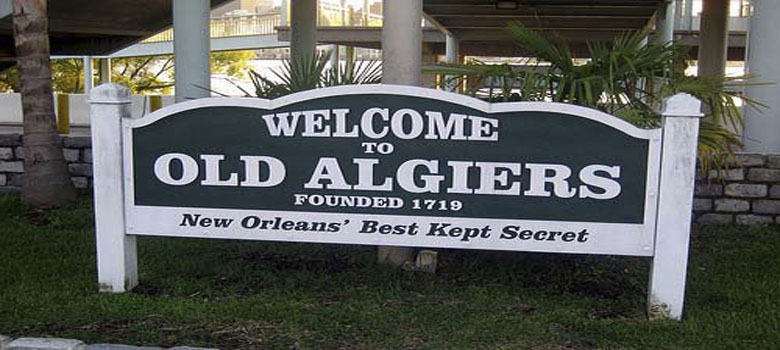
The area known as Old Algiers, nestled in the curve of the Mississippi River’s west bank (which incidentally is not west of the rest of the City of New Orleans), was established in 1719, making it the second oldest part of the city. Originally granted to Jean Baptiste LeMoyne Sieur de Bienville, it was originally part of the “King’s Plantation” that stretched from Plaquemines to Donaldsonville and then to Natchez, Mississippi. Native Americans lived along the river banks before it was settled by the French. For nearly a century and a half, the area served as the place where African slaves were held before they were sold into a lifetime of slavery. Some scholars argue that this place is actually sacred ground, the site of the origins of jazz. The slaves -- frightened, sick, isolated from the families -- quite likely used their tradition of “call and response” and single-line melodies to communicate and comfort themselves and their families. These sounds form the basis of jazz today.

During the years of building New Orleans, Algiers became the site of the city’s powder magazine, for which
Powder Street was name. The city’s slaughterhouse was also located in Algiers, called Slaughterhouse Point in its early history. In 1769, the Spanish took control of Louisiana, and they sold the Algiers land to homesteaders who established large farms and plantations. Two of the most famous of these early landowners were Barthelemy Duverje, who owned most of the property that is now called Algiers Point, and John McDonogh, who lived between Newton and Homer Streets. Several communities developed over the years, including Duverjeville, Belleville, Brooklynville, McDonoghville, LeBeoufville, and Hendeeville. Around 1819, shipbuilding and ship repair operations set up along the riverfront. Later, related industries such as saw mills, lumber yards, dry docks and an iron foundry added to the commercial vitality. By mid-century, most residents depended on the shipbuilding industry for their livelihoods.

The United States Naval Station was sited in Old Algiers in 1848, and large tracts of land were purchased.
By 1894, the facility was in operation and continued to expand until after World War II. For many years, it was the largest employer in Algiers. Old Algiers further prospered with the development of the railroads in the 1850s. At one point, there were 4,000 men working in railroad-related jobs. The railroad yard stretched 22 blocks across Old Algiers in the area that now houses the Riverpointe development, Port Cargo and other industrial uses. During the Civil War, Algiers warehouses were burned and Union troops set up camp in the area. Freed slaves established their own communities in Old Algiers, primarily in the McDonoghville area and Freetown, which will established by John McDonogh for his own slaves, whom he emancipated, and other free people of color.

McDonogh left his considerable wealth to develop a public school system in New Orleans, including
McDonogh 32 in Old Algiers. The Great Fire of Algiers in 1895 destroyed approximately 200 homes in the Algiers Point area and the Duverje Plantation house, which was being used as the courthouse. However, new structures took their place, and soon after the turn of the 20th century, Old Algiers was thriving. For entertainment, Algerines went to theatres, such as Philip FOTO’s Market Theatre and the Folly Theatre, where they could enjoy vaudeville, silent movies and music. There was a lively jazz and burgeoning R&B scene along Newton Street and Teche Street, as well as in the locations such as the Masonic lodges and Knights of Columbus dance halls. Many musicians famous in their day, such as George Lewis, “Kid” Thomas, Peter Bocage, the Matthews Brothers, Freddie Kolhman, Clarence “Frogman” Henry and others, plied their trade in these establishments.

Old Algiers remained fairly self-sufficient through the first half of the century, with corner stores, schools,
churches, bars, restaurants and theatres, but when the railroad yard closed in the 1970a and the oil industry started to shrink, the area suffered from neglect. It would be 20 years before parts of the area began to come back, with renovators scooping up the real estate. Parts of Old Algiers remain neglected, but with the help of a variety of programs, including the Old Algiers Main Street Corporation, new focus is being placed on recreating a thriving Old Algiers community.

Read more history and current events on Algiers in the upcoming issue of The Trumpet in the September/October issue. Sign up for our e-newsletter for Trumpet publication dates and release parties at newsletter@npnnola.com!

Tuesday, August 9, 2011

Whole Foods Wants to Break Agreement with Uptown Residents

By Betsy Stout

Whole Foods has applied to change the ordinance that regulates their operation. Uptown residents believe that this ordinance and it’s provisos were carefully crafted by land use and transportation professionals, including the staff of the city planning commission and national land use expert Dan Mandelker out of St. Louis, and more than happily agreed to by Whole Foods and by property owners Hixon and Sarpy.

The purpose of the provisos was to mitigate the impact of a large grocery store operation that extends into a residential neighborhood with no buffer between it and the residences. The provisos also helped level the playing field as much as possible between this large commercial operation and the small local businesses it joined on Magazine St.Whole Food’s explanation that their customer base has grown such that they have to ask for this expansion of their operation is answered by asking them to please open another Whole Foods location – thus reducing congestion at this location and better serving the community. We would like to suggest that they consider the vacant Lower District location on Annunciation St. where a Schwegmann, then Roberts used to operate.

This would serve the lower Magazine St. neighborhoods, the Warehouse District (which has no grocery store at all), and is very close to the bridge to the West Bank, convenient for people who work downtown but live on the West Bank.They are requesting increased eighteen wheelers, when even the trucks that come now cannot make the turn from Magazine St. on to narrow, residential Arabella. There have been at least 4 different sink holes this summer alone in this block of Arabella. We have offered a solution to their delivery problems that would reduce the impact of their trucks and delivery hours – that is to revisit an original design that recognized that the street cars and buses in the old barn used Magazine St. Although they would not want to reconfigure the entire store at this late date, they could place a loading dock on the Magazine St. apron and unload trucks there all night long (when Magazine St. is empty of traffic) without any increased impact on our streets or residents.

They are asking to have permission for live music, both inside and outside the building, which together with their ABO, makes them an entertainment venue. Changes to the ordinance or title run with the property forever and cannot be written to restrict the use to one tenant such as Whole Foods. Text changes that attempt to restrict the live music to the tenant of Whole Foods are unenforceable according to the staff of the planning commission and the opinion of land use attorneys we have consulted.Whole Foods has managed nicely to have music whenever they wish to date, by applying for a permit for the band. We have no objection to this as it does not create a permanent change in the permitted use of the building as a music hall.

Changes to the ordinance that allows Whole Foods to have displays of flowers, etc, on the apron of the building give Whole Foods an advantage over other small flower shops along Magazine – one in the very next block even – that are prohibited from having sidewalk displays.The mystique of Whole Foods exercises a zombie like influence on some of the young people who live close by – mostly all newcomers to New Orleans, who will agree to anything that will increase their Whole Foods lifestyle experience. These mostly young folks make up the board of ARNA, which is now actually in the process of changing their by-laws to reflect their aim to give bigger businesses free reign on Magazine St. and within the neighborhood. (I must explain this very unusual situation, because to see ARNA in action is to render those of us who understand the ramifications of these actions speechless.)

They voted to allow live music and restrict it to Whole Foods despite the warning from Council member Guidry’s representative Kelly Butler, that such wording was not enforceable. Fortunately another neighborhood organization, Burtheville Association of Neighbors is fastly becoming the neighborhood association of record and will oppose these changes.

The CPC will consider this on AUGUST 23, at 1:30 pm.Short URL: http://katrinafilm.com/public/wordpress/?p=2254

411 NOLA is sponsoring a poetry contest with cash prizes

Details at http://www.411nola.com/2011/08/09/the-poetic-soul-a-contest-for-poets-and-spoken-word-artists/